







Shipping and couriers
eCommerce Packaging Regulation 2026: what’s changing, how to comply and save
What the 2026 EU packaging regulations require for eCommerce: operational checklist, examples, business impacts and how to comply with Qapla'.
Packaging and regulations
The European Union has a clear goal: drastically cut packaging waste. To achieve it, new rules are being introduced that-from August 2026-will directly impact your eCommerce. Ignoring these changes means risking fines, but also missing a strategic opportunity.
Getting ready in time isn’t just an obligation-it’s a competitive advantage. Reducing packaging waste lowers transportation costs, streamlines warehouse processes, and improves brand perception. In this hands-on guide, you’ll find a ready-to-use checklist. Get set to turn a potential threat into a growth lever (and make the most of Qapla’!).
What changes and when
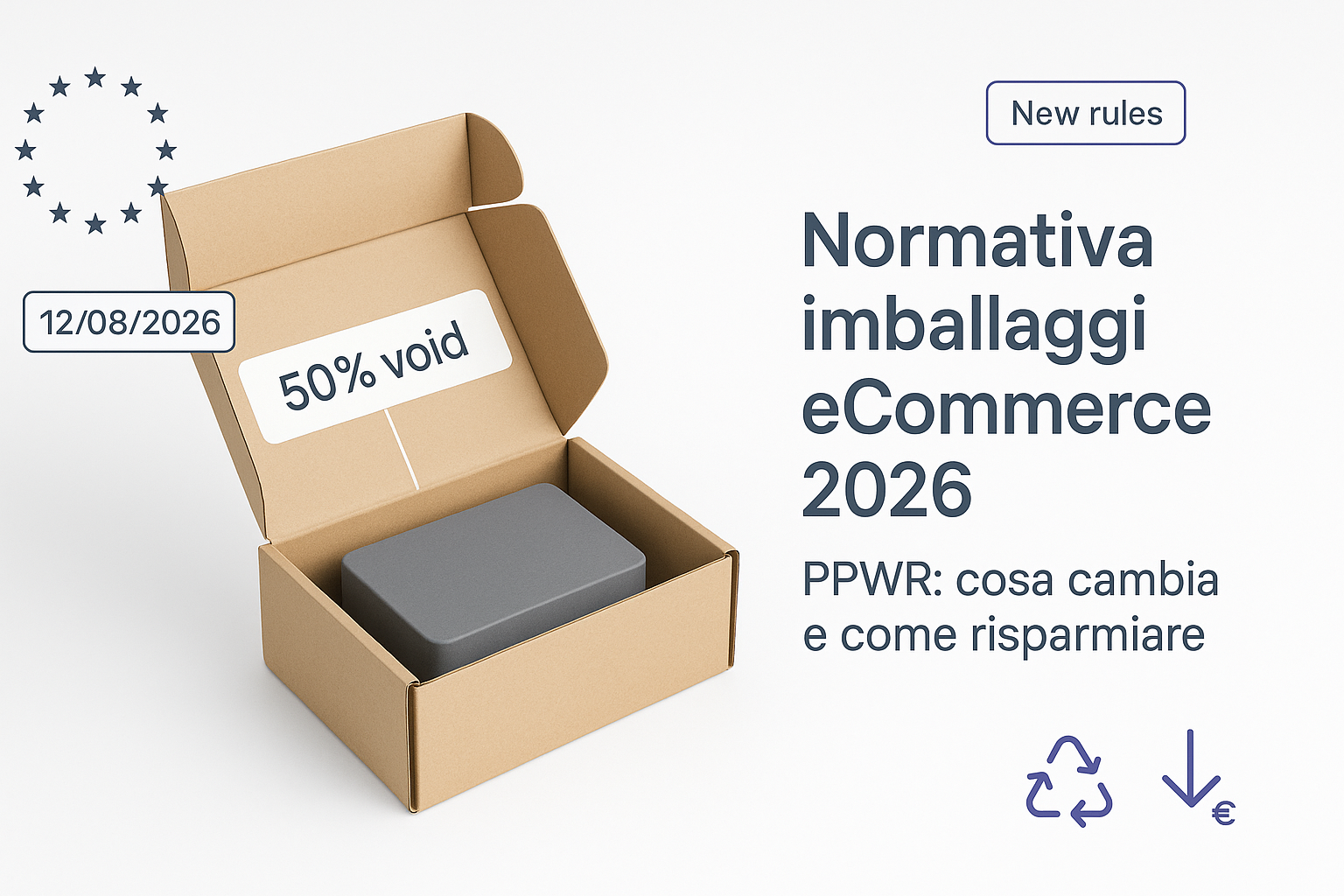
Regulation (EU) 2025/40 (PPWR) has been in force since 01/22/2025 and applies from 08/12/2026. For grouped/transport/eCommerce packaging, a maximum empty space ratio of 50% applies: paper, bubble wrap, and air pillows count as empty space. By 02/12/2028 the Commission will define the calculation method. Harmonised labels and digital marking will arrive via implementing acts by 08/12/2026; waste containers will have to display harmonised labels by 08/12/2028. Recyclability graded A/B/C becomes a requirement from 2030; recycled at scale from 2035.In detail:
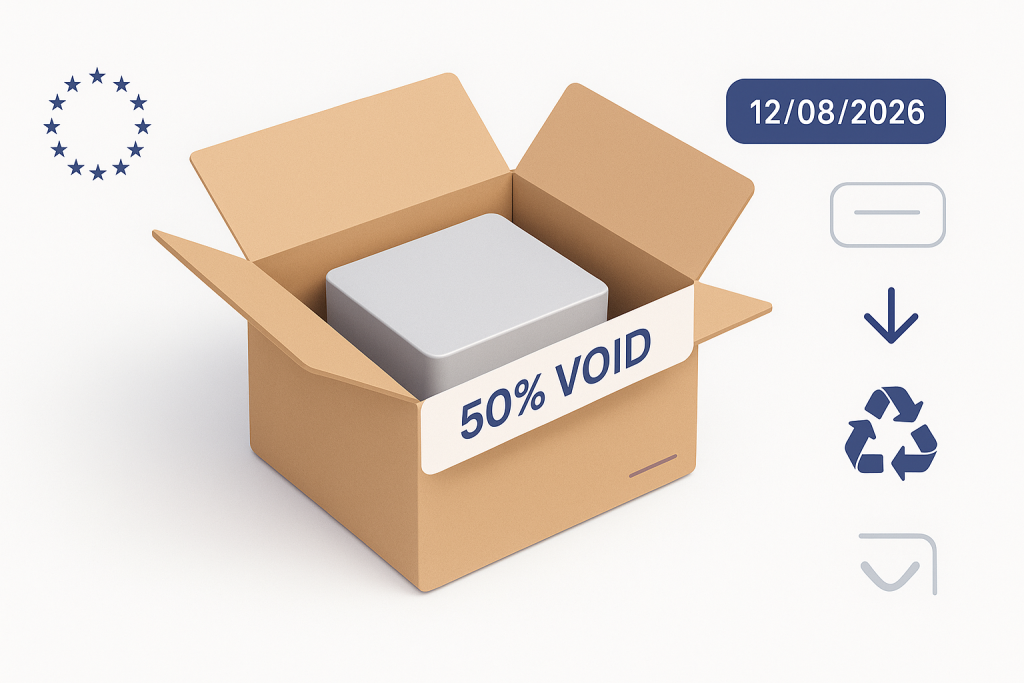
- Packaging minimisation / empty space ratio 50%: packaging must be designed to minimise weight and volume. The “air” inside a parcel must not exceed 50%.
- Recyclability: all packaging must be recyclable at scale from 2030 (with some derogations).
- Reuse and recycled content: specific targets apply to reusable packaging and to recycled content in plastic packaging. Single-use plastic packaging for fresh fruit/vegetables and hotel courtesy kits will be banned-clear direction of travel.
- Clear labelling: packaging must display clear information on composition, correct disposal, and recycled content. Labels will be uniform across the EU.
- Economic contributions: companies must comply with Extended Producer Responsibility (EPR) schemes, paying an eco-fee proportional to weight and material type. In Italy this is the CONAI Environmental Contribution.
- Food-contact packaging and PFAS: from 08/12/2026 you may not place on the market food-contact packaging with PFAS ≥ 25 ppb (single substance), 250 ppb (sum), or 50 ppm (total fluorine). Start a supplier audit now: request MOCA Declarations of Compliance and analytical evidence; replace risky materials.
Sources
- Regulation (EU) 2025/40 (PPWR)
- PPWR summary sheets
- MOCA – Guidelines/Declaration of Compliance (Italian Ministry of Health)
Practical impacts for an eCommerce
This isn’t just paperwork; it’s an operational shift touching every step of your logistics.Materials and formats
Reducing “void” (empty space in the parcel) is the main challenge. If you use one standard box for all products, you’ll need to rethink that. Adopt multiple sizes, letterbox mailers, or fit-to-size packaging per SKU. The goal is to eliminate excess void fill (paper or bubble wrap). This not only ensures compliance but also reduces shipment weight and volume-with a direct impact on freight costs.Dimensional weight & shipping costs
Carriers charge not only by actual weight but also by dimensional weight. If the parcel is large but light, you pay for the space it occupies in the truck. The new rules push you to optimise packaging and, as a result, reduce shipping costs. A more compact parcel can fall into a lower price tier, saving on each shipment.Warehouse & packing processes
Your warehouse and packing process will need to evolve. You should:- Map each SKU to its ideal packaging.
- Consider bundles/kits for multi-item orders to reduce the number of boxes.
- Evaluate reusable packaging, especially for returns or closed-loop cycles (e.g., rentals).
Ready-to-use compliance checklist
Deadline
Risk
Action
| Requirement | Deadline | Risk | Action |
| Requirement | $3999 /year | ||
| Empty space ratio 50% | Aug 2026 | Fines, carrier overcharges | Audit packaging per SKU; identify “air parcels”; introduce right-sized boxes. |
| Recyclability | 2030 (mandatory) | Non-compliance, fines | Replace non-recyclable materials (e.g., bubble wrap) with sustainable alternatives (e.g., recycled paper). |
| Labelling | TBC (in progress) | Fines; disposal confusion for customers | Update labels with harmonised disposal symbols. |
| EPR/CONAI | TBC (in progress) | Fines for non-registration | Check scheme membership and updated fees. |
| Food-contact & PFAS | Aug 2026 | Non-compliance, fines | Verify MOCA certificates and supplier Declarations of Compliance; replace non-compliant packaging. | Buy Now |
How to adapt in 30–60–90 days
30 days – Quick wins
Start with an internal analysis. Map your SKUs and current packaging. Which products ship in oversized boxes? Which are “air parcels”? Audit carrier contracts to understand how they calculate dimensional weight and where you exceed thresholds. Immediately review packaging for your top 3–5 products.60 days – Testing and redesign
Run tests. Try new box/mailers for the SKUs identified in step 1. A/B test to measure impact on costs and customer perception. Update packing rules in your WMS so pickers select the right packaging per SKU. Brief customer care so they can answer client questions.90 days – Full rollout
Once validated, roll out to all SKUs. Set KPIs and reporting to monitor progress (see KPI section). Launch a training plan for warehouse staff. Review contracts with packaging suppliers to ensure you have the right materials.In summary
30 days- Map SKUs ↔ packaging: dimensions, weight, damage, returns, average dimensional weight.
- Audit carrier contracts: dimensional thresholds, surcharges, tolerances.
- Quick wins: remove “too large” formats, switch to foldable inserts, reduce average parcel height by 1–2 cm.
- A/B test formats on 10–20 high-volume SKUs.
- Packing rules in the WMS (or SOPs): bundles/kits, priority for reusable packaging.
- Brief customer care: new packaging and returns policy.
- Rollout across all lines: operator training + printed work instructions.
- KPIs & reporting (see KPI section) + renegotiate carrier contracts based on measured data.
Data, examples, and a mini case study
Let’s take a practical example. A home-goods eCommerce shipped a 1 kg mug set in a 30×25×20 cm box. The carrier calculated dimensional weight with a 5,000 divisor, pricing the shipment at €10 (hypothetical tiers: 0–1 kg → €6; 1–3 kg → €8; 3–5 kg → €10).- Before: (30×25×20 cm, volume 15,000 cm³): Dimensional weight = 15,000/5,000 = 3.0 kg → €10 (3–5 kg tier)
- After: They switched to a fit-to-size box 20×15×15 cm (volume 4,500 cm³): Dimensional weight = 4,500/5,000 = 0.9 kg → €6 (0–1 kg tier).
Where Qapla’ truly helps
Qapla’s three pillars are key to navigating this change.Label printing & carrier pre-assignment rules
- Set labels in 3 clicks and configure carrier pre-assignment and rate comparison.
- Monitor shipments from a single dashboard, spot issues, and turn shipping into marketing with customised tracking pages.
- Transactional emails, SMS, and WhatsApp in multiple languages for delivery statuses; add CTAs and sustainability content (why packaging is changing).
KPIs to monitor
To measure effectiveness, keep an eye on these metrics:- % of void per shipment: aim to minimise it.
- € per shipment: average carrier shipping cost.
- Damage/returns: % of shipments damaged or returned due to poor packaging.
- Packing time: time to prepare a parcel.
- Pre-/post-delivery contacts: number of customer-care tickets.
- NPS/CSAT: customer satisfaction.
- Open/click rate of transactional emails: effectiveness of post-shipping communication.
- Revenue from the tracking page: revenue generated by offers/links on the tracking page.
Frequently Asked Questions
Is the new packaging regulation mandatory for all eCommerce?
Yes. PPWR is an EU regulation and applies to all packaging placed on the EU market, regardless of company size.
What happens if I’m not compliant by August 2026?
Non-compliant companies risk fines and penalties, which vary by Member State.
How can I measure the “void” in my parcel?
You can use specific tools, but the 50% rule means no more than half of the parcel’s volume can be air or filler.
Are reusable packaging solutions mandatory?
No, but the regulation sets specific targets for reuse, encouraging companies to consider this option-especially in closed-loop logistics.
I sell on marketplaces (e.g., Amazon, eBay). What should I do?
The new rules also cover marketplace sellers. Platforms must verify their sellers’ compliance, especially EPR registration.
© Qapla’ Blog, All rights reserved.